
How to Find a Car’s Jacking Points
A step-by-step guide to finding safe jacking points on your car.
- Check your car’s manual, it’ll show exactly where you can place a jack.
- Look behind the front or back wheels – there’s usually a jacking point for each ‘corner’ of the car.
- Find pinch welds, the metal edges under the car with small notches for jacks to slot in to.
- If you have an SUV or 4x4, look for frame rails – thick metal rails that are safe to jack from.
- Avoid any soft or moving parts, like the suspension, exhaust, or floor panels.
- Use a torch and gloves to be able to see more easily and avoid cutting your hands.
- Keep an eye out for markings showing jacking points.
If there’s something mechanically wrong with your car, the chances are you’ll have to jack it up at some point. But the heavy weights involved in jacking up a car can quickly become dangerous if you haven’t exercised extreme caution. What’s more, jacking up your car at the wrong point can not only create the possibility of the jack slipping and the car falling, but can actually cause real damage.
Needless to say, the whole process can be quite daunting if you’ve never done it before. But if you go slowly, take care to find the correct jacking points, and proceed cautiously, it’s an essential skill to get in the bag for whenever you need to change to a spare wheel after a puncture.
Here’s what you need to know.
Why is it important to use the right jacking points?
First of all, let’s establish exactly why there are specific ‘jacking points’ in the first place. What is the need for such precise locations when jacking up a car? And, why can’t we just use any old place for jacking?
Most importantly, failing to place the car jacks correctly underneath your vehicle can seriously damage the vehicle or, in some cases, those working underneath it if it slips. Parts of the undercarriage of the car could get punctured or bent – and this is by no means a cheap or easy repair.
Originally you could jack up a car from practically anywhere, because older vehicles were built on top of heavy-duty metal frames that could take the stress. In a bid to optimise for fuel efficiency and materials costs, however, newer car designs tend to favour a ‘unibody construction’ that’s far less resistant to forces outside the designated points.
Where are the jack points on your car?
So, where exactly are the jack points on your car?
Well, due to the huge variety of cars on the roads today, there isn’t actually a universal jacking point location. Because of so many different car designs, jacking points are likely to differ in location based on the size, age, model, and make of your car. That being said, there are certainly common places to look – as well as clues to help you find them.
As we mentioned in the checklist at the beginning, always start by looking in your vehicle’s user manual or maintenance guide. This should identify the jacking points clearly for you. If you’ve bought your car second-hand or have had it for a number of years, you may not have access to the user manual anymore. If that’s the case, begin by looking at the chassis around each of the four wheels. You’re looking for a reinforced chassis area that’s either a flat plate (usually on larger or older vehicles) or a pinch welded edge.
Here are some common car jacking up points:
1. Near the front & rear wheels
When you need to change car tyres, the most ideal place to jack a car up is near the wheel that you need to change. The benefit here is that the jack doesn’t need to be strong enough to lift, say, 1.5 tonnes, because it’s only ever lifting a quarter of that to get one wheel off the ground. What’s more, having the jack so close to the wheel that’s being removed reduces the chance of the jack slipping, because it’s right next to where the force is concentrated.
2. On the rear differential
From the perspective of not damaging the car, this is hands down the safest jacking point because the differential is already built to balance the weight of the car. But this can be dangerous if you only have one jack, because there’s a much greater chance of the car tipping if it’s not balanced perfectly. So, rather than trying to lift the whole car using one jack in the middle, it’s much safer to slowly jack up each side - either using two jacks, or a jack and two (stable) axle stands.
You’d make use of this jacking point if you need to replace something like bushings or lead springs, or otherwise when modifying the chassis or height of your car. It also allows you to easily access the underneath of your car.
3. On the front and rear crossmembers
A crossmember is a metal (usually steel) structure that runs horizontally across the front or rear of the vehicle. It is designed to structurally support the engine and other components at the front, and to support the stability and handling of the vehicle at the back.
Much like jacking via the differential, jacking with the crossmembers requires you to jack both crossmembers at the same time in order for the car to balance. Jacking via the front crossmember is essential for procedures like oil changes.
4. On both sides of the body
It is possible to jack a car up by using specific points on both sides of the body. But this method is tricky and can be dangerous, as the car is more likely to slip. Moreover, this may also cause damage to the bodywork if the jacking isn’t done properly. If you need to get the car completely off the floor, it’s much safer to jack up each corner and support it with jack stands – but at this point we’d recommend that you take your car to your local Kwik Fit centre. The experts there have specialist equipment to be able to easily and safely inspect your vehicle.
How to jack up a car
Now you know where you can safely jack your car up from, it’s time to learn how. Use the following steps:
- Place a jack underneath the car. The head of the jack should pretty much touch the jacking point before you start jacking.
- Begin to apply pressure onto the jacking point by adjusting the jack. Some drivers like to use a piece of wood to protect the jack head here. You can jack quickly at first as it may take some time.
- Begin to jack slower once you notice the jack has been locked in by the pressure. The car doesn’t need to come off the ground very much for a tyre to be removed - a few centimetres is usually plenty.
- Once the wheel is able to roll, that’s when you know you’ve jacked it up enough for a tyre change.
Which car jack should you use?
As well as specially designed jacking points, the jacks themselves are engineered to be able to cope with heavy loads for extended periods of time. There are a whole range of different types of jack that you might like to consider, but the main types are:
Scissor jacks
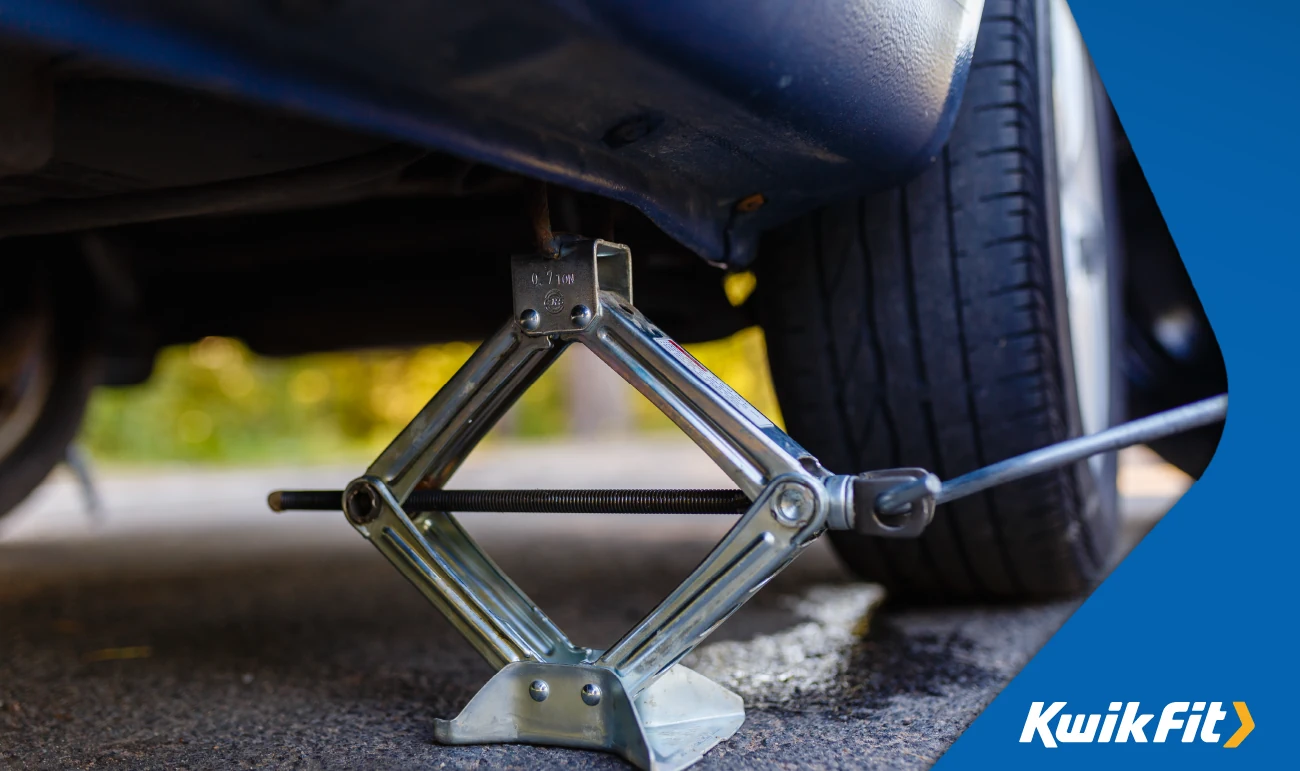
Scissor jacks always used to be the most popular type of car jack. They would come as standard with many cars and vans to aid in the emergency repair of flat tyres, or replacement with a spare wheel. However, now, since run-flat tyres are becoming increasingly popular, this type of jack is fading out in its use.
With the development of other jack designs, scissor jacks are sometimes seen as being less dependable, due to the possibility of them slipping if more complex works than tyre changes are required.
Hydraulic bottle jacks
This type of jack is very small and compact. As such, it is excellent for smaller cars and being kept in the boot in case of emergencies. However, it is not the best option when it comes to SUVs and larger vehicles that require jacking up farther from the ground.
Similarly to the scissor jack, this jacking option can sometimes be unstable, as it has a smaller surface area. To remedy this if you have no other option, make sure to carry a baseplate to balance it out; this can be made from a sheet of metal or hard plywood.
Hydraulic trolley jacks
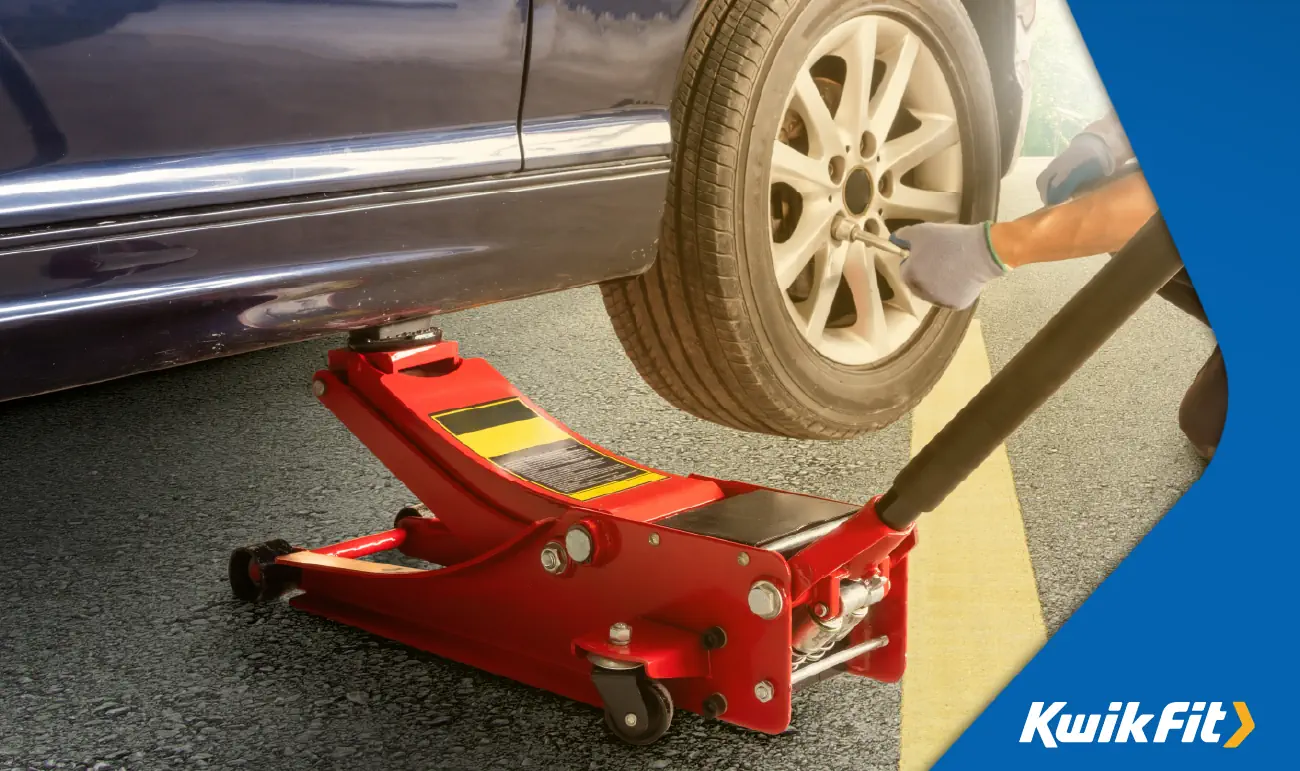
Lastly, hydraulic trolley jacks are a great option if it is stability you’re looking for. They work in a mechanically-similar way to the bottle jacks above, but they come on four wheels and can be rolled about.
They are significantly larger and more stable. However, due to their size, weight, and general bulk, they aren’t the easiest option to carry around in the car, and are more suited to life in the garage.
Let the experts handle it
Jacking up a car can be tricky, and does require some know-how and elbow grease. So, if you’re worried about changing a tyre or inspecting a vehicle part under a jacked-up vehicle yourself, it’s better to leave it to the experts at Kwik Fit. Speak to the technicians at your local Kwik Fit today.