
How to Extend the Lifespan of Your Bike Chain
Jessica Bird | Thursday 16th October 2025 9:10am

When it comes to keeping your bike in top shape, the chain is one of the most important components to care for. A well-maintained chain ensures smooth gear changes, efficient pedalling, and helps prolong the life of your entire drivetrain by making sure there’s always consistent, dependable contact.
Whether you’re commuting through a busy UK city, tackling countryside trails, or enjoying the extra boost of an e-bike, your chain takes the brunt of every journey – so how do you make sure it lasts as long as possible?
Let’s find out.
The essentials for making your bike chain last longer
The quick answer to this question is that the simplest way to extend the life of your bike chain is to combine good riding habits with regular maintenance.
1. Keep it clean & well-lubricated
Dirt, grit, and moisture are the enemies of any chain (and any mechanical component, for that matter!). They accelerate wear by grinding down metal components. Giving your chain a proper clean and lubrication every couple of weeks (or more often in wet weather) will help keep it running smoothly.
For a step-by-step guide, see our blog on how to clean and lubricate your bike chain.
2. Choose the right lubricant
UK weather can be unpredictable, so match your lubricant to the conditions. Use a dry type of lubricant in summer to prevent dust build-up, and a wet lubricant in rainy conditions to protect against rust. For longer-lasting protection, consider chain wax (more on that later).
3. Avoid cross-chaining
Cross-chaining is when you ride in extreme gear combinations, such as the biggest chainring with the biggest cassette cog, or the smallest with the smallest. This puts unnecessary strain on your chain and can wear it out faster. Stick to gear combinations that keep the chain in a straighter line.
How to bring a bike chain back to life
If your chain is looking tired but hasn’t worn past the point of no return, you can restore it with a deep clean and re-lube. Use a proper degreaser to remove built-up grime, then apply fresh lubrication. In some cases, soaking and scrubbing can help to soften up stiff links.
That said, once a chain has stretched beyond recommended wear limits, it’s best to replace it rather than trying to salvage it – you definitely don’t want your chain breaking mid-ride. Moreover, riding on a worn chain can damage your cassette and chainrings, leading to a more expensive repair.
Is it ok to spray WD-40 on a bike chain?
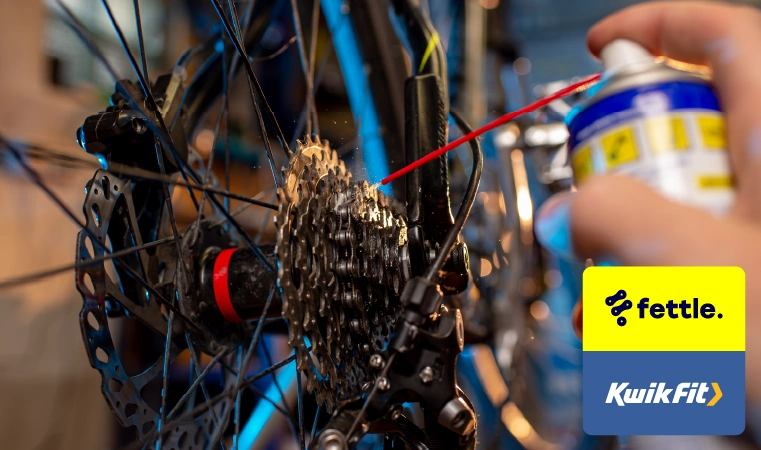
This is a common question among cyclists, and is actually quite a common misconception among people in general. WD-40’s standard formula is actually a degreaser – not really a lubricant. People often mistake it for a lubricant because it’s frequently used to help release seized nuts, hinges, and other mechanical components, but it does this by thinning out accumulated grease and softening rust, rather than by lubricating in the technical sense. What’s more, it’ll largely evaporate off, so you’re then left with a dry joint.
But we should note here that WD-40 is also now a brand name, and they create a number of different products – so don’t just skip a WD-40 product, make sure you’re using the right product. For actual lubrication, it’s always best to use a bike-specific product designed to handle the pressure and friction of riding.
Wax or oil: which is better for bike chains?
So, both have their benefits:
Oil-based lubes are easy to apply, effective in all conditions, and great for most UK riders. And they come as “wet” or “dry” formulations. Wet lubes are especially useful in rainy weather, while dry lubes work well in the summer months because they tend to not be that gummy – so you don’t end up with an accumulation of dust & grime.
Chain wax, on the other hand, offers a cleaner, longer-lasting alternative. It repels dirt more effectively and can extend chain life a bit more effectively than oil-based lubricants, but it takes more time and effort to apply properly.
For everyday commuters and leisure riders, oil is often the most practical choice because of how much easier it is to apply (usually just a quick spray). For enthusiasts and long-distance cyclists, waxing may be worth the extra effort.
How many years does a bike chain last?
Like many mechanical components, the lifespan of a chain depends a lot on how often it’s used – but lack of use and improper storage (i.e. left outside over winter or in extreme heat) can also lead to a reduced lifespan as parts seize and become brittle.
A well-maintained chain might last 2000-3000 miles for regular cyclists. For e-bikes, the extra torque means chains may wear out faster, sometimes in under 1500 miles, but new chains are being developed to account for this as the popularity of ebikes increases.
In terms of years, that could mean anywhere from 1 to 5 years.
How do I tell if my bike chain needs replacing?
The easiest way is to check for stretch (also called elongation). Chains gradually wear as the pins and rollers develop play, which makes the chain slightly longer over time.
A particularly useful method is to use chain wear tools. These are like rulers for a chain. They’re affordable and easy to use – and they slip right into your chain to show much it’s stretched over time.
Some signs to look out for while riding are skipping gears, noisy shifting, or a rough pedalling feel.
As a general rule, replace your chain before it reaches 0.75% stretch. Waiting too long risks wearing out your cassette and chainrings, which are much more expensive to replace.
How often should a bicycle chain be oiled?
This depends on your riding conditions:
- On dry, clean roads, oil every 150–200 miles.
- On wet or muddy rides, clean and re-lube immediately after.
- With e-bikes, chains are under more strain, so check and lube more frequently.
A good habit is to quickly inspect your chain after each ride. If it looks dry or sounds noisy, it’s time for a top-up.
How terrain affects chain longevity
Not all rides are equal. Terrain impacts your chain’s life in a number of different ways – largely relating to how much strain is being put on it, and what the likelihood of accumulating dirt and debris is.
You might expect city commuting to be the easiest on a bike chain, but stop-start traffic, frequent gear changes, and exposure to rain can accelerate wear. With off-road and gravel, dirt and grit find their way into the chain’s links and effectively act like sandpaper, wearing away the metal.
Flat, steady rides are always easier on a chain – but that rarely happens in the real world. For UK riders, wet weather is always the biggest enemy. Water carries grit into your drivetrain and can quickly wash away lube, so it’s crucial to clean your bike and re-lube after any wet ride.
In short
- Keep your chain clean and lubricated.
- Avoid cross-chaining to reduce unnecessary stress.
- Choose the appropriate lube for the weather.
- Replace chains before they become overly stretched.
- Inspect your chain regularly and adjust habits depending on terrain.
Need expert help?
Looking after your bike chain will save you money and keep your rides smooth. But if you’d rather leave the maintenance to the experts, why not book your bike in with Fettle at Kwik Fit? Whether it’s a simple chain check, a replacement, or a full service, our trained technicians can get you rolling again in no time.
Find your nearest Kwik Fit centre with an in-house Fettle station and give your bike (or e-bike) the care it deserves.


Any facts, figures and prices shown in our blog articles are correct at time of publication.
Featured Articles
Is it Illegal to Drive With One Headlight?
Saturday 19th July 2025

Wondering if it’s illegal to drive with one headlight? Learn about the safety risks and penalties of illegal blown bulbs and why you should fix them promptly.
Air Con in EVs & Hybrids: Experts Answer Your Questions
Monday 30th June 2025

Does air con drain EV batteries? Can you use the air con while charging an electric car? Find out the answers to these questions & more from Kwik Fit’s experts.
Why Is Your Car Making a Noise? Fixes & Tips
Friday 13th June 2025

When your car starts making unexpected noises, it can certainly be quite disconcerting; it may be nothing to worry about, but here’s what you need to know.