
How To Check Your Car Battery Health
10-steps to checking your batteries health and keeping your cars moving
- Switch everything off in your car to get an accurate reading.
- Open the bonnet and secure it properly to safely access the battery.
- Inspect the battery for cracks, bulges, leaks, or corrosion around the terminals.
- Check the connections to ensure the cables are tightly secured to the terminals.
- If your battery has a built-in indicator, check whether it shows green (healthy) or red (low charge).
- Use a voltmeter or multimeter to check voltage.
- Test whether your headlights brighten when you press the accelerator, signalling a charging issue.
- Listen to see if the engine sounds laboured when starting, suggesting the battery is struggling to provide power.
- Check for a “rotten egg” smell indicating leaking battery acid.
- Check the manufacturing code to see your battery’s age.
Your car battery is one of the hardest-working parts of your vehicle. It powers the ignition, your lights, the heating system, and even your music. Without it, your car simply won’t run.
So, when a battery fails, it’s more than just an inconvenience. The good news is that with some simple checks and a little routine care, you can extend the life of your battery and avoid unexpected breakdowns.
This guide explains what affects battery health, how you can check it at home, and the steps you can take to keep it in good condition.
Why car battery health matters
Flat batteries are the single most common cause of breakdowns in the UK. And. crucially, keeping on top of your battery’s health means that you’re not likely to be surprised by a failed battery. Indeed, many of these issues can be avoided with a bit of attention.
What affects car battery health?
Batteries don’t usually fail suddenly. Their performance declines gradually, and certain factors speed up the process. Here are the most common ones:
Infrequent use
Batteries lose charge naturally over time. If your car isn’t driven regularly, the battery may not hold enough power to start the engine.
Electrical drains
Leaving headlights, interior lights, or even charging devices plugged in can drain a battery quickly.
Cold weather
Low temperatures reduce a battery’s efficiency. Older batteries are particularly vulnerable to failing on frosty mornings.
Short journeys
Frequent short trips don’t give the alternator long enough to recharge the battery fully, which shortens its lifespan.
Dirty terminals
Corrosion or grime on battery terminals can block the flow of electricity, reducing performance.
Faulty alternator
If the alternator isn’t working properly, the battery won’t recharge while the engine is running.
Age
Most car batteries last between five and seven years. Beyond this, they become less reliable and more prone to failure.
How to check your car battery at home
You don’t need specialist knowledge to get a good idea of your battery’s health. A few simple checks can give you useful insights.
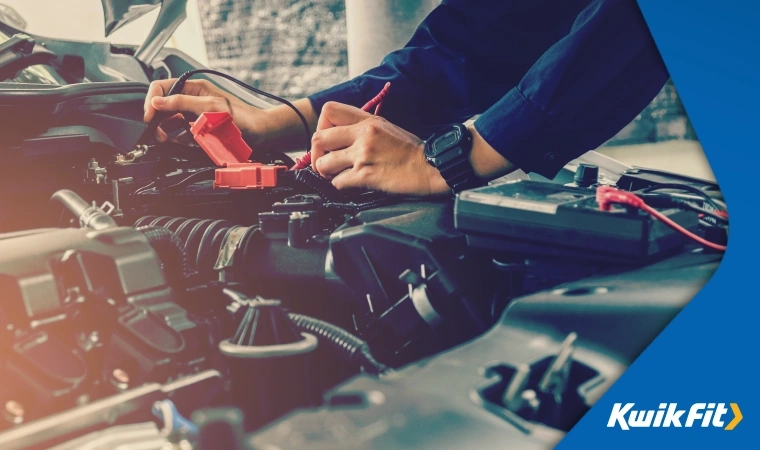
1. Test with a voltmeter
A voltmeter (or multimeter) gives an accurate reading of your battery’s condition and is inexpensive to buy.
- Make sure the ignition and all electrics are switched off.
- Remove the covers from the battery terminals.
- Connect the red probe to the positive terminal and the black probe to the negative.
- A healthy reading should be between 12.4V and 12.7V. Anything lower suggests the battery is undercharged or weakening.
2. Check your headlights
Switch on your headlights and keep an eye on their brightness. Dim lights can point to a weak battery. If they brighten when you press the accelerator, this could indicate a charging problem with the alternator or a battery that’s not holding charge as well.
This is because either the alternator isn’t charging the battery as much as it needs to be while idling, or the battery isn’t able to be charged, so the extra power for the lights comes from the increase in alternator speed as you press the accelerator pedal. Here’s everything you need to know about alternators, if you’re curious!
3. Look for a built-in indicator
Many modern batteries feature a small charge indicator window. Green usually shows good health, while red signals low voltage.
4. Carry out a visual inspection
Look for physical warning signs such as:
- Corrosion around the terminals.
- Cracks or bulges in the casing.
- Leaks or a strong sulphuric smell.
If you notice any of these, it’s best to have the battery checked by a professional because battery acid can be very dangerous to handle, so you really don’t want to wing it if there’s a possible leak.
Keeping your car battery in good condition
Simple maintenance goes a long way toward preventing problems with your car's battery. Here are some practical tips:
Keep terminals clean
Remove any corrosion with a baking soda and water solution and an old toothbrush. It can also help to apply battery clamp grease at this point so that your battery’s terminals are protected from further corrosion.
Drive regularly
Longer journeys give your alternator time to fully recharge the battery.
Protect against cold weather
Batteries tend not to like getting too cold. If possible, park in a garage overnight or, alternatively, use a battery cover to help insulate against freezing temperatures.
Use a trickle charger
For cars that are used infrequently, a smart charger can keep the battery topped up safely.
Check connections
Ensure the cables are secure, as loose connections can cause poor performance.
Monitor the battery’s age
If your battery is more than six years old, consider replacing it before problems occur.
When to replace your car battery
As with almost all electromechanical components, all batteries eventually reach the end of their life - even with good care. Signs it’s time for a replacement include:
- Difficulty starting the engine.
- Electrical faults such as flickering lights.
- Frequent need for jump-starts.
- Visible damage such as swelling or leaks.
If you notice any of these, it’s advisable to replace the battery sooner rather than later.
Free battery health checks at Kwik Fit
If you’re not confident about checking your car battery yourself, the experts at your local Kwik Fit centre can help. We’re always on hand and offer free battery health checks at all of our centres.
Our technicians will test voltage and charging rates, inspect your battery for corrosion or damage, and provide clear advice on whether a replacement is needed – so you’re always driving away with peace of mind that you’re not going to be left stranded on account of a failing battery.
Book your free battery check today and make sure your car is ready for every journey.