
How to Safely Transport Your Bike By Car
A step-by-step guide to keeping your bike secure on your next journey
- Give your bike a quick wipe down to remove any mud and dust.
- Decide on a method: roof-mounted, hitch-mounted, trailer, or internal.
- If carrying your bike in the car, lower your seats, use a dust sheet, and remove a wheel if needed.
- If using a rack, ensure that it doesn’t obscure your number plate and rear lights.
- Wrap any delicate parts of your bike in protective padding if needed.
- Always secure your bike rack and double-check that your bike is safely mounted.
- Place a (secured) rag between any points of contact to protect your paintwork.
- Drive cautiously, remembering height, weight, and length restrictions.
Knowing how to transport your bike safely by car is essential, whether you’re a pro cyclist en route to a competition or a family of four exploring the local trails.
But which method do you opt for? And how do you guarantee that your bike will remain secure and damage-free during transit? Read on for an in-depth breakdown of some different transportation methods (as well as some handy tips).
How to prep your bike before you transport it
Firstly, we'd recommend giving your bike a quick clean to save having to clean up any mess in your car.
You'll then likely need to remove your front wheel, depending on how you decide to transport your bike. This could be simple if your bike has a quick release mechanism, or will require two spanners if not.
Finally, you can wrap delicate parts such as the frame, gears, and handlebars with protective padding. Although it may seem excessive, proper preparation will help ensure your bike arrives at its destination in perfect condition.
Four ways to transport your bike by car
When it comes to transporting your bike both safely and securely, the method you choose can significantly impact both your bike's safety and your driving experience.
Here are some of the most common and effective methods for transporting your bike by car, along with the pros and cons for each.
1. Roof-mounted bike racks
The most common method, a roof-mounted bike rack, attaches to the roof of your car and holds bikes securely on top in an upright position.
- These keep the bike separate from the interior and boot space, saving you both time and effort in preparing your bike and removing ‘dirty’ elements for transportation, essentially, keeping it fully intact. This method is ideal if you are taking long journeys or want to carry more than one bike around.
- However, despite the practicality, these racks can increase wind resistance and fuel consumption. Plus, installing and removing the bike can be challenging due to the height element.
2. Interior transport (inside the car)
This method involves securing the bike safely inside your car, which may require you to remove a wheel or clear out your boot. If you have a hatchback, it is likely to involve folding down seats, but if you are using a spacious vehicle like an SUV or van, it will be easier to accommodate the bike.
- Transporting a bike inside the car offers the best protection from the weather, and generally is better for keeping costs down.
- While this method eliminates the need for external racks, it limits interior space, making it unsuitable for families, groups with more than one passenger, and trips with lots of baggage.
3. Hitch-mounted bike racks (on the back of your car)
If you’re worried about height restrictions and fuel economy, a rear-mounted bike rack that carries your bikes on the back of your car is a good option. These can carry multiple bikes at once in a secure position.
- Hitch-mounted bike racks are easy to install and can safely carry numerous bikes, without limiting space on the roof or in the car for additional storage (like a roof box).
- However, this rack type is slightly more expensive, quite heavy, and can obscure your rear-view visibility, increasing the length of your vehicle too, making parking a challenge.
4. Bike-specific trailers
The final option is getting a bike-specific trailer. This is attached to the back of the car and is designed to transport several bikes at once. This is ideal for bike trips involving families or groups.
- Bike trailers provide more space inside the vehicle and don’t threaten height restrictions like roof-mounted racks.
- However, bike trailers can be harder to manoeuvre and may make parking and reversing a challenge.
Is it illegal to drive with a bike rack in the UK?
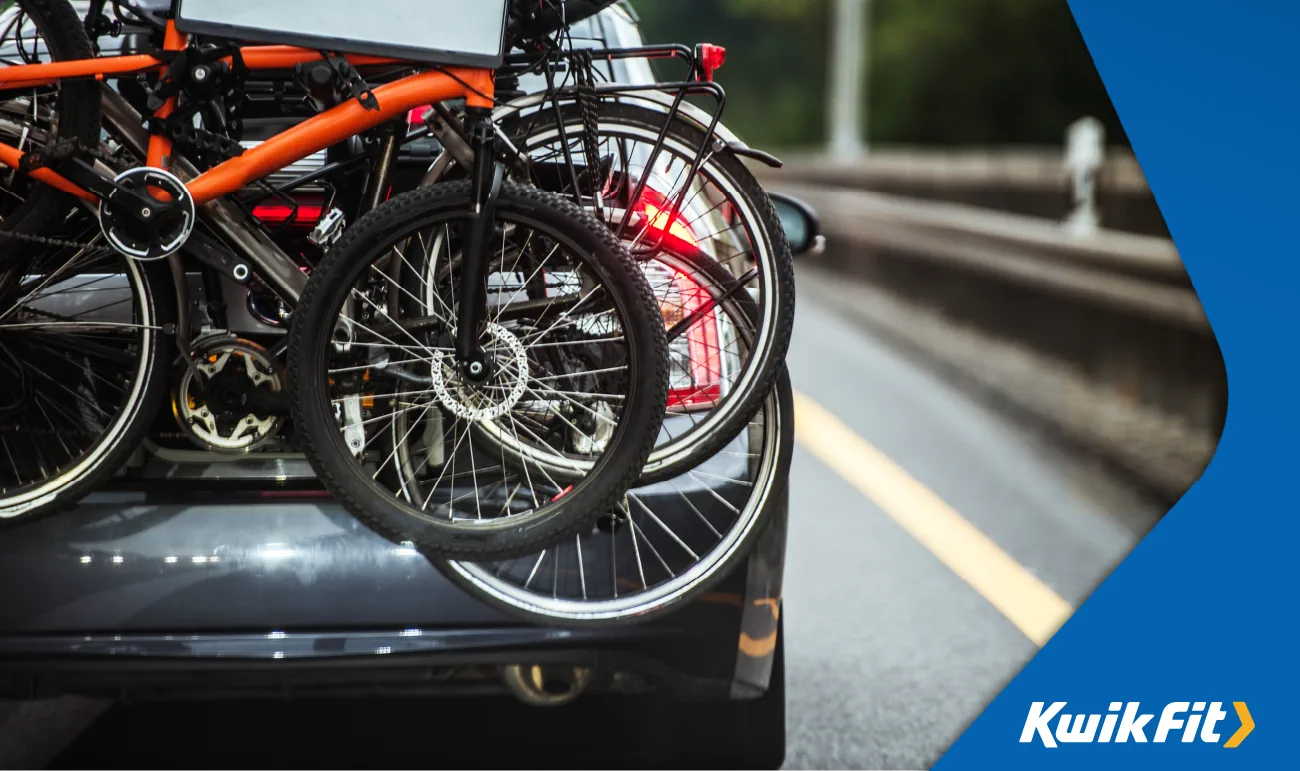
No, it is not illegal to drive with a bike rack. It’s only if the bike rack breaks certain laws that there’s a problem. The bike rack should not obscure your rear lights (brake lights, hazard lights, etc) or your number plate. This is often why bike racks sit higher up on the car, and why bike trailers have their own lights and reg plate attachment.
Your bike rack should also not be dangerous; no parts should be hanging off, overloaded, or loose. If you’ve got a bike that’s poorly attached to the rack, or trailing components, you may well get pulled over.
Tips for driving safely while carrying bikes
When transporting your bike by car, it is important to comply with road and legal regulations. To do this, you should:
- Appropriately secure your bike, whether it be by roof rack or in your vehicle.
- Use a cloth to protect your paintwork at points of contact with the rack (just make sure the cloth won’t dislodge and fly off, causing a hazard to other drivers).
- Drive cautiously, especially if you have any added length, weight, or height to your vehicle as a result of racks.
- Ensure your vehicle’s load doesn’t exceed legal weight limits.
- Watch your speed. Driving too fast with bike racks on can be dangerous.
- Avoid risky manoeuvres such as high-speed overtakes or U-turns when carrying an extra load.
- Consider accessories like blind spot mirrors or wing mirror extensions to help with any reduced visibility as a result of a bulky bike rack.
Get your bike ready for your next adventure
Before heading out on your next adventure, it's important to make sure that not only is your bike transported safely, but also that your bike is well-maintained.
Proper maintenance can make all the difference in ensuring a smooth ride and avoiding potential issues when you reach your destination.
Regularly check your tyres for pressure, inspect your brakes for responsiveness, and make sure your gears are shifting smoothly. If you have any questions regarding your bike's condition, head down to one of our Kwik Fit centres for a free bike check with the Fettle experts. Enjoy your next journey with confidence.