
How to Use Your Hazard Lights Correctly
A step-by-step guide to warn others of an issue with your hazard lights
- Use your hazard lights when your vehicle is stationary and causing an unexpected hazard.
- Activate your hazards if you're the last car in a queue behind an obstruction to alert approaching drivers to brake.
- Avoid using hazards during normal driving conditions, as this can confuse other road users.
- Ensure all your indicator bulbs are functioning, as hazard lights rely on them.
- Using hazard lights does not exempt you from parking restrictions or traffic laws.
- If it’s snowing, foggy, dark, misty, or raining heavily, use hazard lights to warn others of slow-moving traffic.
When encountering unexpected obstructions on the road or in case of an emergency, hazard lights act as an essential signal to other drivers. But, while the name ‘hazard lights’ affords us the luxury of telling us what they’re for, do you know what actually constitutes enough of a hazard to turn them on? And are there times when you shouldn’t turn on your hazards?
Let’s find out.
What are hazard lights?
Hazard lights are a special type of light on the rear of a vehicle that flashes on and off as a warning of hazards, road obstructions, or slow speeds in poor conditions.
Why are hazard lights orange?
Hazard lights flash orange (like indicators) because the colour orange is commonly associated with danger and warnings, helping signal any hazards clearly and quickly to other road users.
Are hazard lights different from headlights?
You’ve likely seen hazard lights used in different situations. You can clearly see when someone has their hazards on because the lights blink on and off, but these aren’t actually different lights from what’s already in the car.
Crucially, hazards don’t flash the headlights or brake lights on and off, only the indicator lights.
Instead of working from different bulbs, the “hazard light” button simply makes all the indicator lights on your car flash on and off at the same time. This can be a super effective way to signal that there’s danger but, used at the wrong times, can actually cause danger.
When should you use hazard lights?
The Highway Code gives clear guidance on when you should be using your hazard lights. Usually, this is in instances where oncoming drivers wouldn’t expect a car to be stopped, such as on a road after an accident. You should use your hazards when:
- Your vehicle is stationary, and you need to warn other road users that you are temporarily obstructing traffic.
- You’re on a motorway or unrestricted dual carriageway and need to warn road users behind you that there’s a hazard or obstruction ahead.
- For example, when there’s a queue of cars driving significantly slower on a motorway due to a heavy snowstorm, it’s not abnormal for a number of drivers to turn on their hazards to warn oncoming traffic to slow down.
- You’re being towed and there’s danger ahead. Cars behind you won’t necessarily be able to see the hazard lights of the towing vehicle, so you can use your hazard lights to warn them.
Using your hazards doesn’t justify dangerous or illegal parking. While it can be helpful for oncoming traffic to see clearly that you’ve parked somewhere you shouldn’t have (even temporarily), turning your hazards on won’t stop you getting a fine or points on your licence if stopped by a police officer or traffic warden.
Not having the hazards turned on means drivers may assume your car is moving, and therefore come dangerously close at a normal speed before realising that your car is stationary. In the worst cases, this can actually cause a potentially fatal pile-up of cars.
When should you not use your hazard lights?
However, there are many circumstances when hazard lights are not the appropriate choice for signalling to other road users. These are as follows.
Don't keep hazard lights on in a queue
Even if you’re static due to a hazard ahead, you should only turn your hazard lights on if you’re the last car in a queue behind the hazard. If everyone turns their hazards on, then the result can be quite dazzling and result in drivers not being able to see ahead to potential changes in the situation.
It also makes it harder to see, for example, visual directions given by emergency personnel, such as instructions for everyone to pull over to let an ambulance through.
Don't use hazard lights while driving
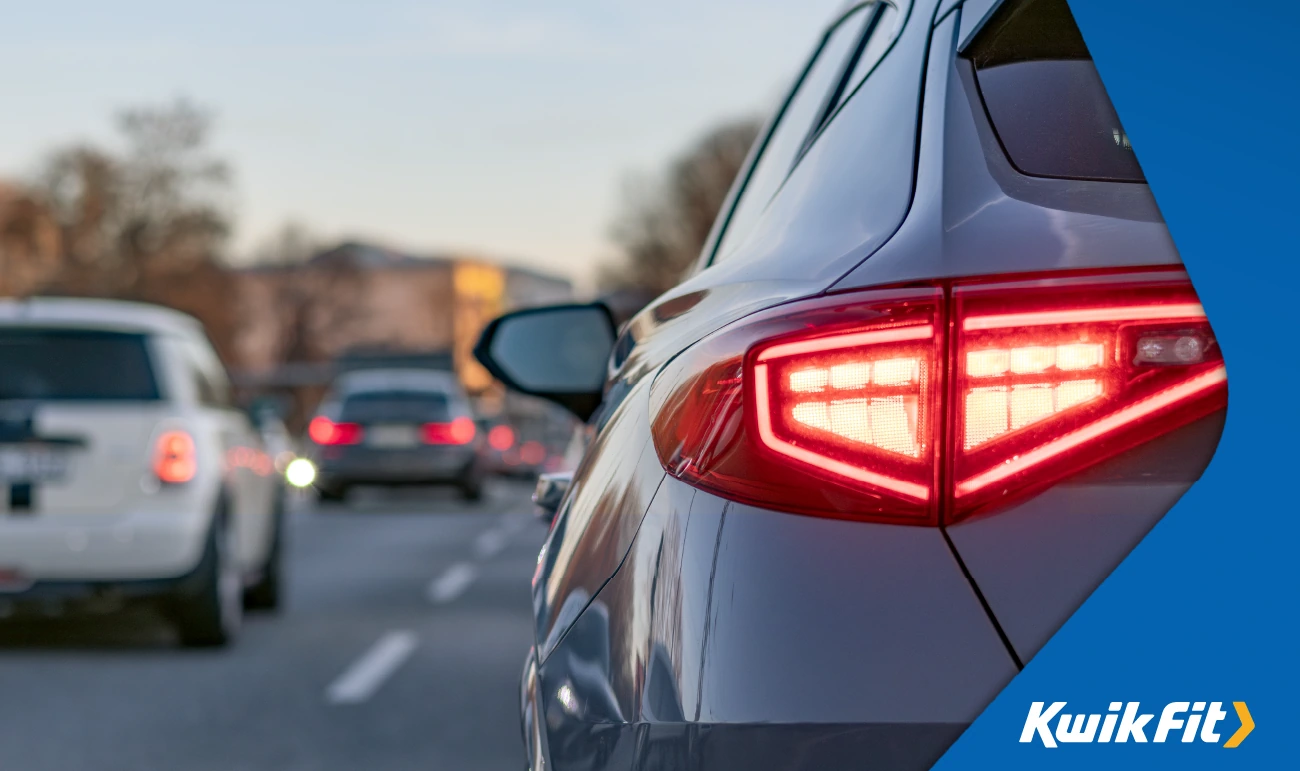
The Highway Code is also quite specific about not using hazard lights while moving, as they can dazzle and confuse other drivers, which may then cause them to make errors in judgment that lead to accidents. The exceptions to this rule have already been listed above and include when you’re being towed, when there’s a hazard in the road, and when visibility is poor.
If you do need to use your hazards while driving, you should only turn them on long enough to ensure that cars behind have seen them and responded. You should then turn them off.
Do hazard lights mean "sorry" or "thank you"?
Sometimes, drivers may “flash their hazards” at drivers behind them in an apologetic or thankful gesture. Usually, a hazard flash by a driver to another is meant as a “thank you” for letting them pull out or for making space to let them merge into a crowded lane.
While this seems polite and is a very common practice on the UK’s roads, it’s important to remember that this is not the intended use of hazard lights and still may cause confusion. Using your hazards as a thank you is also not in line with The Highway Code, so try to simply raise a hand in a thank you gesture if you can.
Stay safe & visible on the roads with Kwik Fit
Your hazard lights are great at reducing danger on the roads, but they won’t work as well if any of your indicator bulbs are blown. Make sure your car’s bulbs are all functioning as they should with regular servicing and maintenance from the experts at your local Kwik Fit Centre.
Contact us or book in for a free vehicle safety check to ensure your bulbs are shining brightly today.