
6 Tips For Driving Safely Around Cyclists
Jessica Bird | Friday 13th February 2026 11:10am
In recent years, the number of cyclists on the roads has increased significantly. Not only is it a cheaper and healthier way to travel, but cities such as London are now offering bike hire schemes and cycle lanes that make travelling on two wheels easier than ever.
While cycling is generally considered a safe activity, collisions and accidents with motorists do happen. To make the highways safer for everyone, here are six tips for driving around cyclists.
Cycling road safety statistics
Before we share our tips for motorists sharing the roads with cyclists, let’s set the scene and look at what the latest figures show.
- Since 2004, pedal cycle traffic has increased by 36%, meaning there’s a much greater variety of road users jostling for space on the morning commute.
- Despite there being more cyclists on roads, fatalities were down 39% between 2004 and 2024.
- That said, the number of serious injuries increased by 16% over this 20-year period, too, suggesting that collisions are still posing a threat to cyclists.
According to GOV.UK’s Road Casualties Pedal Cycle Factsheet, the most common road safety factor allocated to pedal cyclists in fatal or serious collisions (FSC) with another vehicle was “ineffective observation by either the driver or rider or pedestrian”.
How to drive safely around cyclists
Here’s a quick summary of the six core things to remember when sharing the road with cyclists.
- Regularly check mirrors and blind spots, especially at junctions, roundabouts, and in slow or busy traffic.
- Always look carefully before opening your car door to avoid hitting passing cyclists.
- Make your intentions clear by indicating early when turning, pulling out, or changing position.
- Give cyclists plenty of space when overtaking (at least 1.5 metres) and wait if it’s not safe.
- Watch for cyclists’ signals and movements, which may indicate turning or changing direction.
- Follow the Highway Code, respect cycle lanes and stop lines, and give cyclists time and priority where required. l.
1. Check your mirrors and blind spots
As a driver, it’s essential to check your mirrors frequently so you're always aware of your surroundings. Many collisions occur simply because a cyclist wasn’t seen in time, often hidden in a in a blind spot or obscured by other vehicles.
Cyclists can be especially difficult to spot when pulling out of junctions, approaching roundabouts, or navigating through stop-start traffic. Staying alert and giving cyclists space not only helps prevent accidents, but supports safer roads for all.
For more road safety advice, read our Top Tips For Driving Safely In Traffic or explore our Guide to Riding in Cycle Lanes, to understand how cyclists use road space.
2. Check for cyclists before opening your door
After parking, most drivers won’t do a proper check behind them before opening their car door, or will only look out for other vehicles. In fact, research from Cycling UK revealed that 35% of motorists admit to not looking for cyclists before opening their doors.
Cyclists are much harder to see than cars, and they may be travelling past at speed when you want to get out.
- To avoid a collision, look in your wing mirror and check your blind spot before opening your door.
- It’s also worth getting into the habit of opening the driver’s door with your left hand, as this can prompt you to look over your shoulder. This is sometimes known as “The Dutch Reach” and is encouraged by many road safety organisations.
3. Signal before manoeuvring
It might sound obvious, but using your indicators in good time can make a huge difference when it comes to improving road safety. Doing this should come as second nature when you’re in a car, but far too many accidents occur when drivers fail to give others a warning as to what they’re about to do.
Remember to give plenty of time when indicating to
turn right or left, when moving over, or pulling out of a parking space. Not
only does this help to show other drivers what your intentions are, but it also
means cyclists can react accordingly and stay safe on the roads.
4. Give cyclists enough space
When overtaking cyclists, you must give them enough space. The Highway Code states that you should leave as much room as you would if you were overtaking a car.
- It was recently updated to specify that you need to leave at least 1.5 metres when overtaking a cyclist up to 30mph.
- This is especially important if there’s a strong wind or the roads are wet, as the cyclist may veer over into the road or skid off course.
- If there isn’t enough space to pass safely, or if the road ahead appears to narrow or bend, it’s best to hold off.
Remember, the cyclist may be travelling faster than you think, and you could end up pushing them off the road. If there is an oncoming car, you’re approaching a hill, or it’s a blind turn, you should also avoid overtaking.
Bear in mind that cyclists may be required to move suddenly if there is a hazard on the road. For example, they may need to avoid a pothole or an opening car door. If you’re unsure about their intentions, always wait rather than making an irrational decision.
5. Learn to recognise cyclist signals
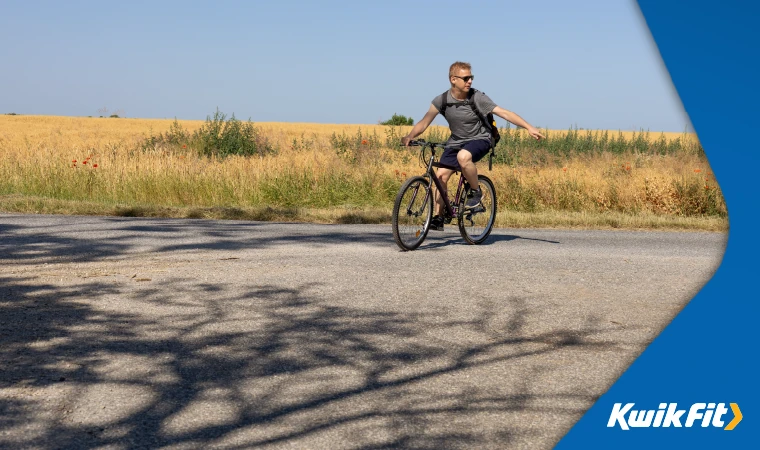
Cyclists often use arm signals to show their intentions, but sometimes they can’t do this because they need to brake and steer. Certain movements, such as looking over their shoulder, may also indicate that they are turning, changing direction or pulling out. Look out for these signals when driving, and make sure you give them the time and space they need to manoeuvre.
6. Follow the rules of the road
A sure fire way to improve road safety for both motorists and cyclists is by following the Highway Code. Always make sure you abide by road signs, including ‘stop’, ‘give way’ and traffic light signals.
It’s also worth bearing in mind that some stop lines allow cyclists to get to the front of the traffic so they can see better. As a driver, you must always avoid driving into these areas and give the cyclist plenty of time to set off when the light is on green.
You should also never park or drive in marked cycle lanes. Not only is this a road offence that could see you getting fined, but it can also put cyclists in danger.
What are the new rules for cyclists in the UK?
In January 2022, the Highway Code was updated to give cyclists, as well as pedestrians and horse riders, more priority on the roads. This means cars and larger vehicles will need to give more leeway to cyclists, particularly at junctions.
Read our blog about the new Highway Code regulations for more detail, or read the summary below.
- Hierarchy of road users: drivers now have increased responsibility to protect cyclists and pedestrians as the least vulnerable road user.
- Junction priority: cyclists going straight have priority over turning vehicles at junctions.
- Drivers must treat cyclists like motorists when joining roads, waiting for a free section. Safe overtaking: drivers must leave at least 1.5 metres when overtaking cyclists.
- The Dutch Reach is encouraged actively to prevent “car dooring”.
- Cyclists don’t have to keep left or use lanes so long as they ride “no less than half a metre” from the kerb.
Staying safe and sharing the roads
Whether you’re in a car, van, or cycling, respecting the rules of the road and other road users is essential for safety. As well as knowing your Highway Code, it’s also essential to keep your vehicle safe, with regular servicing and maintenance (whether you prefer two wheels or four).
At Kwik Fit, we offer free brake, tyre, and vehicle safety checks at all our locations, with free bike checks available at our Fettle locations, too. Find your nearest centre today, and stay safe out there.


Any facts, figures and prices shown in our blog articles are correct at time of publication.
Featured Articles
Is it Illegal to Drive With One Headlight?
Saturday 19th July 2025
Wondering if it’s illegal to drive with one headlight? Learn about the safety risks and penalties of illegal blown bulbs and why you should fix them promptly.
Air Con in EVs & Hybrids: Experts Answer Your Questions
Monday 30th June 2025
Does air con drain EV batteries? Can you use the air con while charging an electric car? Find out the answers to these questions & more from Kwik Fit’s experts.
Why Is Your Car Making a Noise? Fixes & Tips
Friday 13th June 2025

When your car starts making unexpected noises, it can certainly be quite disconcerting; it may be nothing to worry about, but here’s what you need to know.