
Controversial Car Door Handles: Design & Safety
Jessica Bird | Wednesday 19th August 2026 4:44pm

The cars on today’s roads look drastically different to how they did twenty, or even ten, years ago. For one, automotive design is generally sleeker, more high-tech, and more aerodynamic - and this even extends to door handles.
Often overlooked as a functional feature, door handles have undergone a transformation in recent years, owing mostly to the pioneering designs of Tesla.
The main change? Car door handles increasingly sit flush with the bodywork and, in some models, are electronic. But, for all their innovation, these new ‘hidden’ car door handle designs have come under criticism lately, with some countries even banning them entirely. Read on to find out why.
How have car door handle designs evolved over the years?
Before we meet the modern car door handle designs being dubbed as ‘controversial’ by the press, let’s briefly look at how we got here:
- 1950s-1960s car door handles were simple, lever-like chrome-plated options. They were functional, but their metal design made them heat up in the sun (a bit like seatbelt plugs).
- The 1970s saw cars getting larger, and door handles evolved to match. The 70s introduced a keyhole into handles and a push-to-open button. At the time, this was revolutionary, as it connected to a built-in locking system that levelled up car security.
- By the 1990s, the modern car door handle had emerged. What is most familiar to use today - the pull-out plastic handle - became widespread until the late 2010s, on account of its durability and logical design.
- By the 2010s, innovative new designs were emerging. And now, in EVs especially, door handles have all but disappeared from car silhouettes.
A closer look at new car door handle design
As car technology has evolved, so, too, has car door handle design. Some of today’s smart cars don’t require drivers to unlock their cars manually, or even push a button. In fact, some “keyless” models only need their driver to be within a certain range of their car before it unlocks.
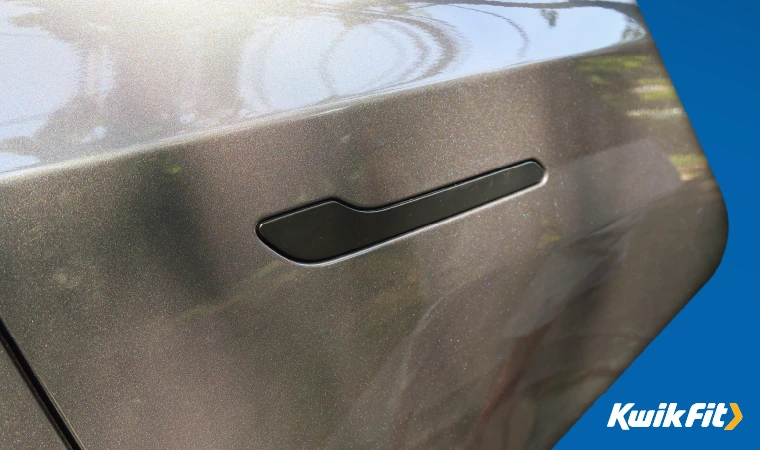
Hidden or ‘pop out’ car door handles
Many modern cars now have their car door handles hidden in the bodywork, appearing only when gently pushed and activated by an electrical push-button release on the inside. This includes cars like:
- Tesla Model 3, Model Y, Model X, and Model S
- Hyundai Ioniq 5, Ioniq 6, and Ioniq 9
- Kia EV6 and EV9
- And some models from manufacturers like Jaguar Land Rover.
The effect is a sleek, flush silhouette without visual disruption and, arguably, a more aerodynamic vehicle. In recent years, again chiefly owing to Tesla, the lack of visible door handles has become synonymous with innovation and cutting-edge technology. To many, the sleeker the car, the fresher the tech.
How do hidden car door handles work?
Some flush door handles are not electronically operated, and can be opened by pressing down on one end of the flat handle to “pop” it out from the bodywork to give you purchase to use it as normal.
Others, however, rely on motorised mechanisms to open. With these models, the general gist is:
- Proximity detection technology within the car senses when your key fob is nearby (ie: when you’re returning to your parked car after being in the supermarket).
- When you’re close enough to the car, a signal is sent to small internal motors or “actuators”.
- The handle will pivot outward or angle slightly, allowing you to grip it and open the door.
- Since the locks are electronic, when you pull the deployed handle, an electronic microswitch - rather than a traditional steel cable - is triggered.
Albeit innovative, it’s this electric opening mechanism that gives these door handles the potential to be dangerous when things fail.
What’s the problem with hidden car door handles?
In recent months, there have been numerous reports of incidents where passengers and drivers have been unable to open their doors after crashes. Users have described difficulties with opening car doors from the outside and, more concerningly, from the inside using the electrical push-button releases. In some cases, this has even caused fatalities.
Both of these mechanisms rely on an e-latch (a door latch controlled by an electronic mechanism), which itself requires an electrical signal or “command” to operate properly.
In a world where doors need electricity to open, if a car’s battery is flat, or if it's been damaged in an accident, how can drivers and passengers get out? This conundrum is exactly what countries like China have been considering when rolling out their ban on certain car door handle types. More on this below.
The safety risks of electronic car door locks
As we’ve said, if a car loses power, then pop-out handles can fail to deploy, trapping people inside or preventing individuals from getting in from the outside.
And that poses several problems:
- Delayed rescues: Emergency services workers may struggle to get to the individuals within the car, delaying urgent medical care that may be needed.
- Confusing/distressing drivers: In high-stakes situations like accidents, passengers are likely to already be distressed and faulty handles won’t help.
This handle design also has several general problems for drivers day-to-day:
- Cold weather: Flush handles are difficult to open during icy or snowy conditions.
- Complex repairs: Unlike the simple mechanisms in traditional car door handles, electronic versions require motors, sensors, and wiring that is harder to fix, and costlier, too.
Getting a handle on car safety
While these types of door handles have been around since 2012, countries are now beginning to intervene on account of the safety risks they can pose.
China’s ban on hidden door handles
After several high-profile accidents, China announced a world-first ban on ‘retractable’ or hidden car door handles. The ban includes both fully electric door handles and the hidden push-to-open models.
From the 1st of January 2027, any new car sold in China will be legally required to have a mechanical release on the inside and outside of every single door (except the boot).
The ban was announced by the Ministry of Industry and Information Technology in February 2026, giving drivers and manufacturers plenty of time to respond. In fact, Tesla has already announced its design changes.
The law is highly detailed, specifying that the outside handles must have a recessed space of at least 6cm by 2cm by 2.5cm for a hand to hold the handle for manual opening. And, on the inside, the new rules specify that there must be “how to open” signage.
Even if the car loses power, mechanical handles will still allow the doors to be opened manually.
Are other countries banning hidden car door handles?
As of August 2026, no other countries have announced a ban on these car door handles, but that doesn’t mean that they aren’t investigating their safety. The US, Australia, and some European countries are actively scrutinising these designs and considering similar rule changes.
Let Kwik Fit handle your vehicle’s safety
Want peace of mind about your car’s safety? Book in for a Free Vehicle Safety Check today or contact your local centre to discuss any issues you might have.
For the latest updates from the automotive industry, distilled into readable insights, keep up to date with our blog and guides. In the meantime, you can rely on your local Kwik Fit to handle any vehicle safety concerns you may have.


Any facts, figures and prices shown in our blog articles are correct at time of publication.
Featured Articles
Is it Illegal to Drive With One Headlight?
Saturday 19th July 2025
Wondering if it’s illegal to drive with one headlight? Learn about the safety risks and penalties of illegal blown bulbs and why you should fix them promptly.
Air Con in EVs & Hybrids: Experts Answer Your Questions
Monday 30th June 2025

Does air con drain EV batteries? Can you use the air con while charging an electric car? Find out the answers to these questions & more from Kwik Fit’s experts.
Why Is Your Car Making a Noise? Fixes & Tips
Friday 13th June 2025

When your car starts making unexpected noises, it can certainly be quite disconcerting; it may be nothing to worry about, but here’s what you need to know.